What Is the Impact of Agritech on Food Security?
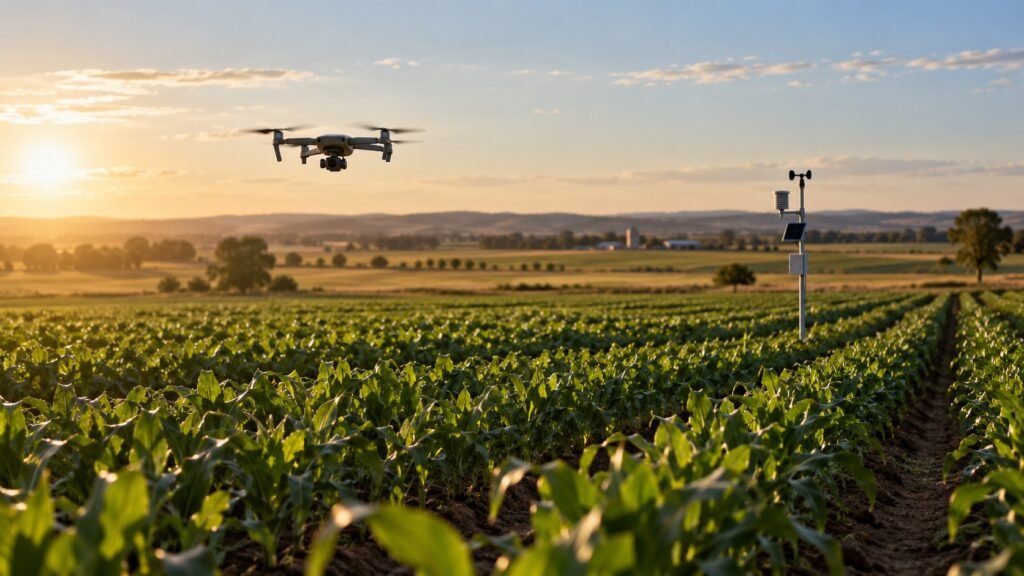
Agritech improves food security by increasing agricultural productivity, cutting water and input waste, catching crop problems earlier, reducing post-harvest losses, and connecting farmers to markets, finance, and information. It also helps food systems absorb shocks like drought, pests, and supply disruption. But it has real limits: cost, weak rural infrastructure, unequal access, and technology dependence all cap how much it can deliver.
That is the short answer. The longer one is more interesting, because most coverage of this topic gets it half right. The standard framing treats agritech as a yield machine: add drones and AI, grow more food, hunger falls. Production matters, but it was never the whole equation. A record harvest does nothing for a family that cannot afford groceries, and a smart irrigation system cannot rewrite who owns the land or controls the supply chain. The useful way to understand agritech’s impact is pillar by pillar, honest about where the technology moves the needle and where something else has to.
How Agritech Maps to the Four Pillars of Food Security
Food security rests on four pillars: availability, access, utilization, and stability. Food has to exist, people have to be able to obtain it, the body has to be able to use it, and all three have to hold steady over time. Agritech can touch every one of them, which is exactly why it matters more than a simple yield story suggests.
| Food-security pillar | What agritech does for it |
|---|---|
| Availability | Produces more food and preserves more of what gets grown |
| Access | Links farmers and buyers to markets, finance, and price information |
| Utilization | Improves traceability, quality monitoring, and nutrient-focused production |
| Stability | Predicts and responds to drought, disease, weather, and supply shocks |
Reading the impact through this table is what separates a serious analysis from another listicle of shiny farm gadgets. The technologies are only as valuable as the pillar they strengthen.
What Is Agritech?
Agritech, sometimes written agtech, is the use of technology across agriculture and the broader food supply chain. It is not just machinery sitting in a field. It runs from seed and soil, to the farm, to storage, to transportation, to the market, and finally to the consumer.
The toolkit is wide and getting wider:
- Artificial intelligence and analytics
- Precision agriculture and GPS-guided equipment
- Drones and satellite imagery
- IoT sensors for soil moisture and crop health
- Robotics and automation
- Smart irrigation systems
- Biotechnology and improved seed
- Weather forecasting and climate modeling
- Digital marketplaces and mobile apps
- Agricultural finance and insurance platforms
- Cold-chain and storage monitoring
- Supply-chain and logistics software
The Food and Agriculture Organization frames digital agriculture in similar terms, covering precision farming, climate-smart practices, supply-chain optimization, and market access as parts of a broader shift in how agrifood systems work. The point worth holding onto: agritech is a chain, not a device.
Why Food Security Needs More Than a Bigger Harvest
Here is the idea most agritech coverage skips. A bumper crop does not equal food security. It is necessary sometimes, but it is never sufficient on its own.
A record harvest fails to feed people when:
- Crops spoil before they reach anyone
- Roads or distribution networks break down
- People cannot afford what is on the shelf
- Farmers cannot reach a functioning market
- Next season’s harvest gets wiped out by drought
- Seed, fertilizer, or fuel becomes unavailable
- The food that is available is not nutritious enough to keep people healthy
Every item on that list points at a different pillar. Only the first few are about production at all. This is why the strongest agritech interventions are the ones aimed at access, stability, and post-harvest loss, not just raw output. Grow more and lose more, and you have gained nothing.
How Does Agritech Improve Food Security?
This is the core of it. Each of the following does real work, and each maps to a pillar rather than to a vague promise of progress.
Precision agriculture raises productivity per unit, not just per acre
Precision agriculture uses GPS-guided equipment, variable-rate fertilizer, soil sensors, satellite imagery, and field mapping to apply the right input in the right place at the right time. The goal is often not maximum output. It is more output per gallon of water, per pound of fertilizer, per acre, per labor hour. That efficiency protects availability while easing the environmental strain of farming, which matters for the sustainability of the whole system.
AI detects crop problems before they spread
Machine vision and predictive models handle pest identification, disease detection, crop-stress analysis, yield forecasts, and irrigation recommendations. Satellite and sensor data feed the system in near real-time. The practical value is time. Catching a disease or a water-stress problem before visible symptoms turn severe can be the difference between a manageable loss and a ruined field.
Smart irrigation cuts water waste
Soil-moisture sensors, automated drip systems, evapotranspiration data, and weather-integrated scheduling let farmers water precisely instead of by habit. In a world of tightening water scarcity, using less water to grow the same food is not a luxury. It is a resilience strategy, and it directly serves the stability pillar in drought-prone regions.
Better storage and cold chains attack post-harvest loss
A large share of food is lost after harvest and before it ever reaches a consumer. Temperature and humidity monitoring, smart warehouses, solar-powered cold storage, route optimization, and inventory prediction all reduce that loss. FAO specifically highlights digitally monitored storage, solar cold chains, and technology-enabled logistics as tools that cut post-harvest losses, improve market access, and help stabilize prices. Preserving food already grown is often cheaper than growing more, and it improves availability without a single extra acre.
Digital marketplaces widen access
Mobile platforms give farmers price discovery, direct selling, buyer matching, market information, and electronic payments. The lazy version of this story is “cut out the middleman.” The accurate version is subtler: intermediaries sometimes perform genuine logistics work, and the real gain is reducing information asymmetry and improving coordination between the people who grow food and the people who need it. The World Bank describes digital agriculture as most useful exactly where weak information and coordination, not merely low yields, are the binding constraint.
Agritech expands access to finance
Digital lending, satellite-based risk assessment, crop insurance, warehouse-receipt financing, and alternative credit scoring help farmers get capital they would otherwise be denied. The food-security link is direct. If a farmer cannot finance seed, fertilizer, equipment, or storage, next season’s food supply suffers before it is even planted. Financing is often the quiet bottleneck behind a hungry year.
Climate tools strengthen resilience
Drought forecasts, heat-stress detection, weather models, climate-resilient seed varieties, and early-warning systems help farmers prepare for shocks instead of merely reacting to them. The shift agritech enables here is from reactive disaster response toward proactive risk management, which is one of the most important moves a food system can make as extreme weather grows more frequent.
Robotics eases labor constraints
Autonomous tractors, robotic harvesting, automated weeding, and drone spraying can keep production reliable where farm labor is scarce or seasonal. Worth stating both sides plainly: automation can stabilize output where workers are hard to find, and it also changes the kind of work available in rural communities. A credible analysis names both effects rather than promising robots will simply save farming.
Biotechnology makes crops tougher
Drought tolerance, disease and pest resistance, improved nutrient profiles, and genomics-assisted breeding all help crops survive the conditions that would otherwise cause a shortfall. The food-security mechanism is what matters here, not a rerun of the GMO debate: hardier crops mean fewer catastrophic losses in a bad year.
Agritech’s Biggest Contribution May Be Stability, Not Peak Yield
This deserves its own section because it inverts the usual assumption. A technology does not have to produce record harvests to improve food security. Often its real value is reducing how badly the bad years go.
Picture two farms across four seasons.
- A conventional farm yields: 100, then 110, then 65 in a drought year, then 105.
- A technology-enabled resilient farm yields: 103, then 108, then 89 in that same drought, then 106.
The second farm barely outperforms in good years. Its advantage shows up in the collapse that does not happen. Drought, disease, or an input shortage produces a shallower dip instead of a crater. That variance reduction, smoothing the supply rather than maximizing the peak, is one of agritech’s most underrated food-security effects. Stable supply keeps prices calmer and keeps households out of the crisis that a single failed harvest can trigger.
The Risks and Limits of Agritech
A piece that only sells the upside reads like a brochure. Agritech has genuine limitations, and naming them is what makes the rest credible.
High upfront cost
Sensors, equipment, subscriptions, connectivity, and training all cost money that smallholder farmers frequently do not have. The technology that would help them most is often the technology they can least afford.
The rural digital divide
Tools that assume constant broadband, cloud access, or a modern smartphone are out of reach where that infrastructure is thin or absent, which describes many of the regions with the highest food insecurity.
Farmer data and privacy
As farms digitize, hard questions follow. Who owns the farm data? Can it be sold? Can lenders or insurers use it against the farmer? What happens to the data if the provider goes under? These are not hypotheticals as more of the value chain runs on someone else’s platform.
Vendor dependency
If essential farm systems depend on one proprietary platform, the farmer inherits that vendor’s outages, price hikes, discontinued products, and incompatibilities. From a resilience standpoint, dependency is still dependency even when it is digital, and reducing dependence is supposed to be the whole point.
Cybersecurity
Connected farms and digitized supply chains introduce cyberattack and system-failure risk into food production. As agriculture becomes an information system, it takes on the vulnerabilities of one.
Unequal adoption
Large producers can deploy technology far faster than smallholders, which can widen existing gaps. Recent research on digital agriculture makes the point sharply: productivity gains do not automatically translate into equitable food access. Who benefits is a question the technology alone does not answer.
What Agritech Cannot Fix on Its Own
Technology makes a food system more efficient. It does not decide who owns the land, who controls the infrastructure, or whether households can afford to eat. Food security also depends on land ownership, access to capital, seed and fertilizer supply, processing capacity, transportation, energy, trade policy, purchasing power, and geopolitical stability. A sensor cannot legislate, and an algorithm cannot redistribute.
That gap is where the ownership and policy questions live, and it is worth one clear look before returning to the technology itself.
Foreign Ownership of US Farmland and Food Security
Foreign ownership of American farmland comes up often in food-security debates, and it deserves accurate framing rather than alarm. Under the Agricultural Foreign Investment Disclosure Act of 1978 (AFIDA), foreign persons, which can include individuals, companies, and governments, must report their US agricultural land holdings to the USDA.
The USDA reported foreign holdings of roughly 46 million acres of US agricultural land as of December 31, 2024. To keep that in perspective, foreign entities hold a small share of all US farmland, and Chinese holdings account for less than one percent of total foreign-owned agricultural land. Much of the recent growth in foreign ownership overall has been tied to renewable-energy projects rather than food production. Farm Bureau analysis of a 1.58-million-acre increase in foreign-held agricultural land between 2022 and 2023 attributes it primarily to renewable-energy investment, while noting a decline in acreage held by Chinese-based entities.
That decline is the detail most fear-driven coverage omits. The drop in Chinese-held acreage stems partly from a Chinese investor reducing holdings tied to a Southwest Texas renewable-energy project, and partly from the USDA reclassifying acreage once attributed to Chinese investors but later confirmed to be held by a US asset-management company operating in Chinese markets. The story is not an unchecked nationwide buying spree.
Where the legitimate national-security concern lives is proximity, not acreage. Foreign investment can pose national-security risks when land is bought near US military installations, and the USDA has been added to the review process run by the Committee on Foreign Investment in the United States so that agencies like the Department of Defense can assess such transactions. Roughly half of US states have also passed or proposed restrictions on foreign or specifically adversary-nation ownership of farmland, often focused on parcels near sensitive sites. That is the substance of the issue: who owns the land next to the base and the grain terminal, and whether that ownership enables surveillance or leverage, not a simple headline about acreage.
The reason this belongs in an agritech article is the contrast. Technology can make the food system more productive and resilient. It cannot determine who owns the underlying assets or whether food stays economically within reach. Those are policy questions, and they need policy answers.
Could Agritech Make the US Food System More Resilient?
Bringing it home to domestic ground, the same tools that help globally apply to US food security. Precision agriculture stretches water, fertilizer, fuel, and labor further. Controlled-environment agriculture, greenhouses, and appropriately sited vertical farming can distribute production closer to where people live. Better grain and cold storage reduce domestic losses. Supply-chain visibility software shows where food is, where shortages are forming, where transport is failing, and where inventory needs redirecting. Early-warning systems track weather, pests, crop disease, and market disruption before they cascade.
None of this is a silver bullet. All of it makes the system fail more gracefully, which is the entire game in a country exposed to hurricanes, droughts, and supply shocks.
Real-World Examples of Agritech and Food Security
Evidence beats theory, so three brief cases.
Smallholder services at scale. The World Economic Forum has reported on an agritech initiative working with around 7,000 chilli farmers that was associated with an 18% increase in absolute profits, with plans to scale the model much wider. The gain came from bundled digital services, not a single gadget.
Digital inputs and information. A World Bank project has used e-vouchers to help tens of thousands of smallholders access improved agricultural inputs alongside digital soil and farm data, with projected yield increases for some key crops. Access to inputs and information, delivered digitally, moved the outcome.
Storage and logistics. FAO points to digital price information, monitored storage, cold chains, and technology-enabled logistics as mechanisms that reduce food loss and improve market access. This is the post-harvest and access story in practice rather than in principle.
How Much Does Agritech Matter to Global Food Security?
Zooming out to the global picture, hundreds of millions of people still experience hunger, and billions more live with moderate or severe food insecurity. Those numbers move year to year, but they remain enormous, and no amount of farm technology erases the underlying causes on its own.
Here is the honest conclusion. Agritech is not a cure for hunger. Hunger persists from poverty, conflict, displacement, and unequal access even when enough food physically exists. Agritech is best understood as a force multiplier. It makes production, logistics, information, and resource use more efficient and more resilient. Point it at the right pillar and it moves real numbers. Expect it to solve everything and it will disappoint, because the hardest parts of food security were never engineering problems.
Where Agritech Is Heading
Looking forward, the trajectory is toward integration rather than isolated pilots.
AI farm advisors
Conversational, data-driven guidance delivered to a farmer’s phone, tuned to local conditions.
Autonomous equipment
Tractors and harvesters that run with minimal supervision, easing labor constraints further.
Cheaper satellite monitoring
Falling costs putting field-level remote sensing within reach of smaller operations.
Robotics as a service
Automation rented rather than bought, lowering the capital barrier that currently locks out smallholders.
Gene-edited climate-resilient crops
Varieties bred for the specific stresses of a warming climate.
Smart warehouses and autonomous logistics
Storage and transport that manage themselves and flag problems early.
Predictive shortage monitoring
Systems that forecast food shortages before they hit, giving responders time to act.
FAO’s current push toward scalable digital ecosystems, rather than scattered one-off technology trials, points the same direction. The future value is in tools that connect, from farm to market to early warning, as a single system.
The Bottom Line on Agritech and Food Security
Strip it down to the mechanism and the whole topic gets clear. Technology produces an agricultural outcome, that outcome strengthens a specific pillar of food security, and that pillar produces a real consequence for real people.
| Technology | Immediate effect | Food-security effect |
|---|---|---|
| Soil sensor | Better irrigation timing | More stable production |
| AI disease detection | Earlier intervention | Lower crop loss |
| Cold-chain monitoring | Less spoilage | Greater availability |
| Digital marketplace | Better buyer access | Higher farmer income and access |
| Weather forecasting | Earlier drought prep | Greater stability |
| Warehouse financing | Less distress selling | More stable farm businesses |
| Robotics | Reduced labor constraint | More reliable production |
Agritech earns its place in food security when it works that chain all the way through, from the tool to the pillar to the household. It is a lever, and a powerful one. It is not the whole machine, and the parts it cannot reach, ownership, affordability, policy, and access, are the parts that decide whether anyone actually eats.
Frequently Asked Questions About Agritech and Food Security
What is the impact of agritech on food security?
Agritech improves food security by raising productivity, cutting post-harvest loss, improving climate resilience, and connecting farmers to markets and finance. Its impact is strongest when it strengthens all four pillars of food security, not yield alone, and it is limited by cost, infrastructure, and unequal access.
How does agritech increase food production?
Through precision agriculture, improved seed, smart irrigation, AI-driven crop management, and automation that all help farmers grow more efficiently and lose less to pests, disease, and water stress.
Can agritech reduce food prices?
It can help by lowering production costs and reducing waste, which eases pressure on supply. It does not guarantee lower retail prices, since those also depend on markets, policy, and distribution beyond the farm.
How does AI improve food security?
AI detects crop disease and stress early, forecasts weather and yields, optimizes irrigation, and improves supply-chain decisions, all of which reduce losses and strengthen the stability of food supply.
How does agritech help small farmers?
It can widen access to market information, finance, and better inputs, and raise both yields and income. The benefit depends heavily on affordability and connectivity, which remain real barriers for many smallholders.
What are the disadvantages of agritech?
High upfront cost, the rural digital divide, data privacy and ownership concerns, vendor dependency, cybersecurity risk, and the danger that gains flow mainly to large producers while smallholders are left behind.
Can agritech prevent food shortages?
It can reduce the risk and severity of shortages through early warning, climate resilience, and better storage and logistics. It cannot prevent shortages caused by conflict, poverty, or policy failure on its own.
How does technology reduce post-harvest losses?
Temperature and humidity monitoring, smart and solar-powered cold storage, route optimization, and inventory prediction keep more harvested food edible on its way from farm to consumer.
How much US agricultural land is held by foreign investors?
The USDA reported roughly 46 million acres of foreign-held US agricultural land as of December 31, 2024, which is a small share of all US farmland. Chinese-held land is under one percent of that foreign-owned total and has declined in recent reporting.
The Hard Baseline
Agritech is a multiplier, not a miracle. It makes food systems more productive, more efficient, and more resilient, and its clearest wins come from reducing losses and softening bad years rather than chasing record harvests. Run the chain from tool to pillar to household and the genuine value is obvious.
The limits are just as real. Technology cannot set who owns the land, who can afford the food, or what the policy allows. A resilient food system needs the engineering and the ownership, the innovation and the access, working together, because the pieces agritech cannot reach are the ones that ultimately decide who eats.